



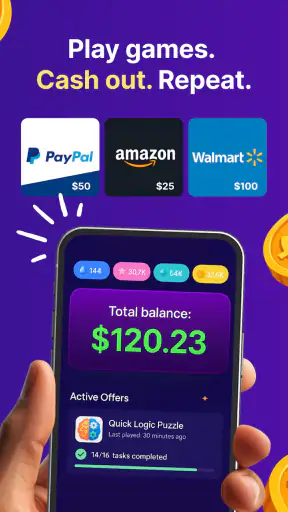
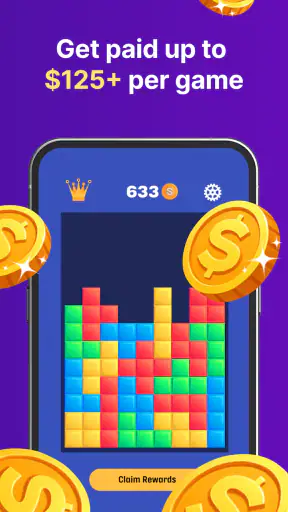
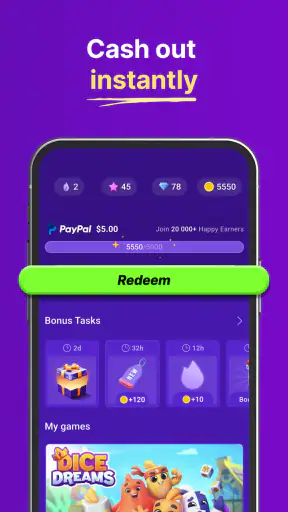
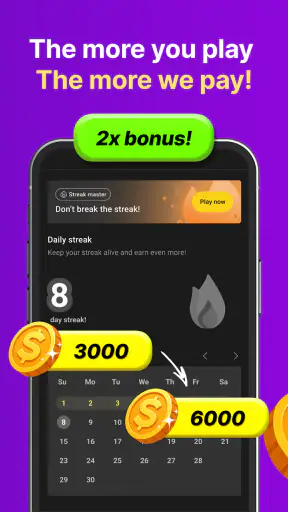
I approached Snakzy: Earn Money & Rewards as an entertainment app rather than as a serious income source, and that distinction matters. Its appeal is simple: you play mobile games and work toward rewards such as PayPal or Amazon gift cards. In my experience, that makes it more interesting than a standard game-discovery app, but also more demanding than the cheerful promise suggests. You still need patience, consistency, and a willingness to try games that may not become personal favorites.
Developed by eneba.com, Snakzy is free to install and sits in the entertainment category. It has reached over one million installs, with an average rating of 4.5 from around 44 thousand ratings and roughly 6 thousand written reviews. Those figures suggest that the basic idea connects with a large audience, although popularity does not remove the need to examine how the experience fits your own habits.
The app is marked Mature 17+, runs on Android 7.0 or later, and its current version is 0.0.133. I would describe it as a reward-focused game hub: the entertainment comes from the games you choose, while Snakzy provides the structure for discovering them and working toward redemption. That makes the app most convincing for people who already spend spare minutes playing on their phone.
How Snakzy feels in everyday use
The central idea is easy to understand
The first strength is clarity. You do not need to learn a complicated points economy before getting started. The basic routine is to browse the available opportunities, choose a game, play it, and keep an eye on progress toward a reward. That straightforward loop is more approachable than apps that bury their purpose beneath surveys, shopping tasks, or a long list of unrelated activities.
I also like the separation between entertainment and reward hunting. Instead of opening a dedicated cash-back tool and searching for something to buy, you can use games as the activity itself. For someone who already plays during a commute, while waiting for an appointment, or during a short evening break, the idea feels less intrusive than adding another chore to the day.
There is an important mental adjustment, though. Snakzy is not a replacement for paid work, and I would not install it expecting dependable earnings. The rewards should be treated as a bonus attached to gaming, not as a guaranteed return for every minute spent. That expectation protects the experience from becoming frustrating when progress feels slower than anticipated.
A practical routine works better than random tapping
My most useful approach would be to treat the app like a small personal experiment. At the beginning of a session, I would look through the available games and choose one that seems enjoyable enough to play repeatedly. Then I would give that title a fair trial instead of jumping between every option. Constant switching can make the activity feel like administrative work rather than entertainment.
A good everyday scenario is a person who has a few scattered pockets of free time. They might play for ten minutes in the morning, return to the same title during lunch, and continue for a short period at night. That pattern is more realistic than expecting a single long session to produce a meaningful result. It also helps reveal whether the game itself is worth the time when the reward element is removed.
I would keep a simple note of which game I selected and what goal I was pursuing. This is not because Snakzy is difficult to understand, but because reward apps can encourage users to lose track of why they opened them. A quick record helps answer a useful question: am I enjoying the game, or am I continuing only because I have already invested time?
Where the reward concept is genuinely useful
The strongest use case is for casual players who want a little extra motivation to try mobile games. Many people download a title, play once, and forget it. A reward target can give that first session a clearer purpose and encourage users to explore games they might otherwise ignore.
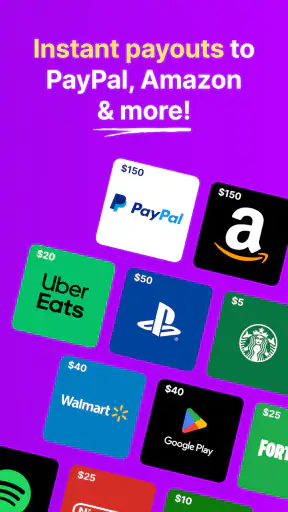
It can also suit someone who prefers small, occasional rewards over a large but uncertain promise. PayPal and Amazon gift cards are familiar reward formats, so the destination is easier to understand than an obscure virtual currency. I would still read the redemption requirements carefully inside the app before investing substantial time, because the practical value depends on how attainable the selected reward feels.
Another less obvious benefit is that Snakzy can act as a filter for game discovery. Instead of searching the wider app store without direction, you begin with a focused set of entertainment options connected to a personal goal. That does not guarantee that every suggestion will match your taste, but it can reduce the effort of finding something new for a spare afternoon.
The experience is not the same as a normal game library
Compared with a conventional game-discovery app, Snakzy adds a reason to return, but it also changes how you judge each title. In a normal library, I would choose a game because of its genre, controls, art style, or reputation. Here, the reward path can influence the decision just as much. That is useful when motivation is the problem, but it can distract from whether the game is actually fun.
Compared with survey and task-reward apps, the entertainment angle is a clear advantage for people who dislike answering questions or completing shopping offers. You are at least spending the time on an activity that can be enjoyable. The trade-off is that game-based progress may require more repeated attention than a quick task, and the value of that time depends heavily on your personal tolerance for mobile gaming.
Compared with playing games directly through the usual app-store route, Snakzy offers a more purposeful path but less freedom to choose solely on taste. If you already know exactly which games you want, the extra reward layer may not add much. If you like browsing and trying unfamiliar titles, it has a stronger reason to exist.
Small habits that make the app less frustrating
I would begin with the reward goal rather than with the game. Look at what you are working toward, decide whether the required effort feels reasonable, and only then choose an activity. This reverses the common habit of starting a game impulsively and discovering later that the target does not suit your schedule.
I would also avoid treating every session as a race. Playing while distracted can make a game feel tedious, and rushing through a title you dislike defeats the entertainment purpose. A better test is to ask whether you would willingly play the same game for a few minutes without the reward attached. If the answer is no, move on instead of forcing yourself through a long routine.
Finally, I would check my progress at sensible intervals rather than repeatedly reopening the app. Constant checking creates the impression that nothing is happening and turns a casual activity into a source of irritation. A planned check after a few sessions is more useful and keeps the reward from taking over the experience.
The main weakness is the value of time
The central limitation is not the idea itself; it is the uncertainty of whether the time spent feels worthwhile to you. A free app can still be expensive in attention. If the available games are not appealing, or if progress toward a reward feels too slow for your schedule, the whole arrangement becomes less attractive than simply playing a game you already enjoy.
This is why I would not recommend Snakzy to someone looking for predictable financial results. The app may be entertaining, but entertainment is subjective, and reward progress is not the same thing as an hourly wage. Anyone who needs reliable income should look elsewhere rather than trying to turn this kind of app into a financial plan.
There is also a potential motivation trap. Once a user has spent time on a game, they may feel compelled to continue just to avoid wasting that earlier effort. I think this is the most important limitation to recognize. If the game stops being enjoyable, the sensible choice is to reassess rather than allowing the reward target to dictate every decision.
Another point of friction is that the app’s value depends on the available selection at the moment you use it. A reward hub is only as appealing as the games it presents to a particular player. Someone who enjoys broad casual gaming may find plenty to explore, while a person with narrow genre preferences may run out of appealing choices quickly.
Who should install it
Snakzy is a good fit for adults who already play mobile games casually and like the idea of attaching a small reward to that pastime. It is especially suitable for people with fragmented free time, because short recurring sessions are easier to fit into daily life than a fixed long commitment.
I would also recommend it to curious players who enjoy trying new games but need a nudge to give unfamiliar titles a chance. The reward structure can make experimentation feel more purposeful. It is less suitable for someone who wants a polished, single-game experience, because the app’s focus is on the surrounding reward journey rather than on delivering one deep game of its own.
Parents should pay attention to the Mature 17+ age classification. That rating makes Snakzy a poor choice for younger children, even if the individual games a user encounters seem harmless. Adults should also keep normal spending and screen-time boundaries in place; a reward-based loop can encourage more play than originally intended.
I would skip it if you dislike mobile games, have very limited patience for progress systems, or expect every minute to translate into a clear monetary return. In those cases, a conventional entertainment app, a game selected directly for its quality, or a more transparent reward service may be a better match.
What I would check before committing time
Before settling into one game, I would inspect the in-app reward details and make sure I understand the goal I am pursuing. I would pay attention to the type of activity required, the stage at which progress is recognized, and the practical steps involved in redemption. These details matter more than the headline promise because they determine whether the routine fits your available time.
I would also test the experience with a short session first. Do the games load comfortably on your device? Does the selected activity hold your attention? Is progress easy to follow? Those questions can be answered quickly and prevent you from building a daily habit around an app that does not feel natural.
Another useful test is to compare Snakzy with what you would otherwise do during the same free period. If the alternative is already playing a game you love, Snakzy may not improve your entertainment. If the alternative is aimless scrolling and you enjoy the suggested games, the app has a stronger case. The real competition is not only other reward apps; it is every other use of your spare attention.
My final view after weighing the trade-offs
Snakzy works best when you see it as a playful reward layer, not as an income platform. Its free access, familiar gift-card direction, and simple game-centered concept make it approachable. The strong user response, including a 4.5 average and more than one million installs, supports the idea that many people find the format appealing.
My recommendation is therefore specific: install it if you already enjoy casual mobile games and would appreciate an additional reason to explore them. Start slowly, choose games you can genuinely tolerate, and judge the experience by both enjoyment and reward progress. Do not let a target persuade you to spend hours on something you no longer like.
For me, the app’s clearest success is that it turns game discovery into a more purposeful activity without requiring the user to treat it like a traditional job. Its clearest weakness is that the reward can make mediocre gaming feel more valuable than it really is. Use Snakzy for entertainment with a bonus attached, and it makes sense; use it as a dependable money-making tool, and it is the wrong choice.


